
Introduction
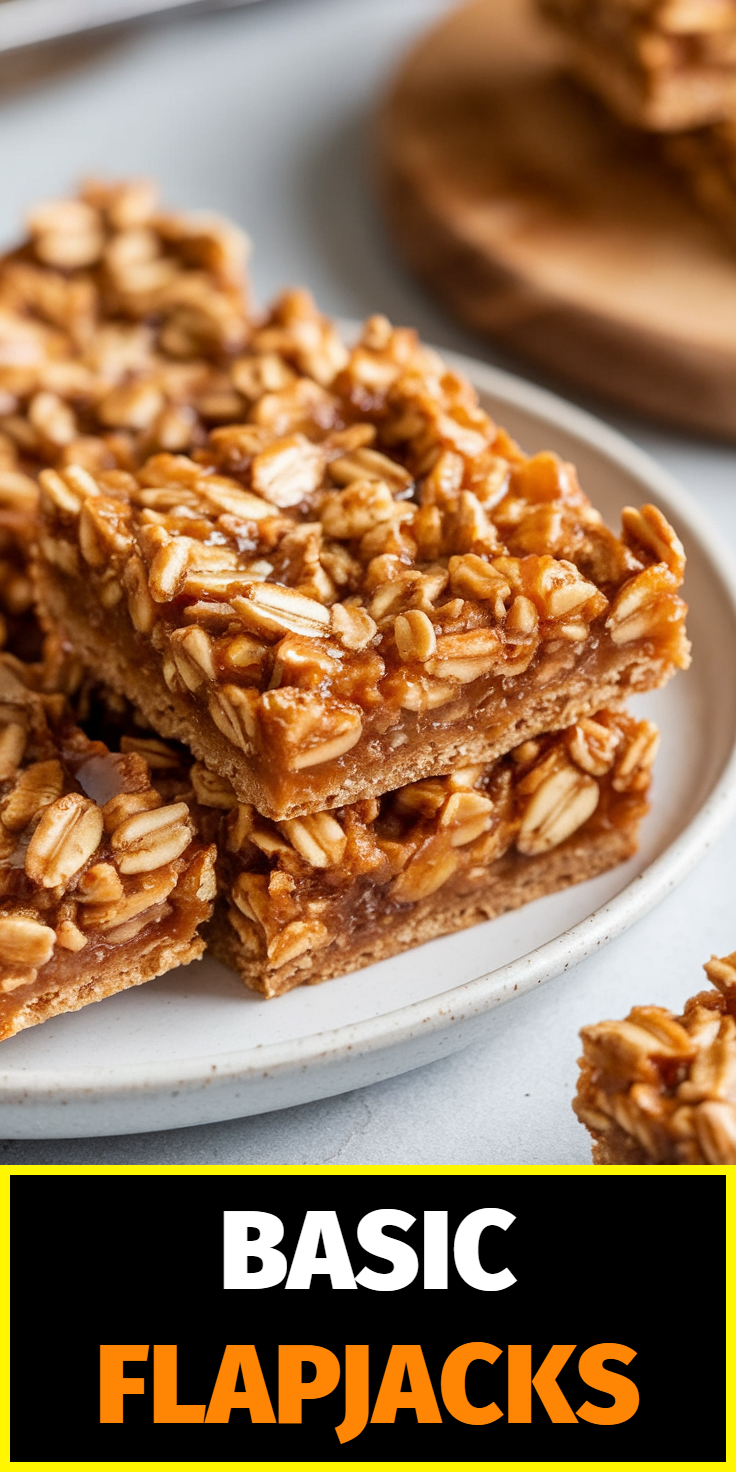
Basic flapjacks are a British baked oat bar that comes together in one saucepan and delivers a chewy, buttery texture with crisp edges. The recipe uses only five ingredients—brown sugar, butter, golden syrup, oats, and heat—making it a reliable weeknight bake that yields enough for 10 bars. They’re equally at home in a lunchbox, on a tea tray, or as a quick breakfast carb.
Recipe Details
- Prep Time: 10 minutes
- Cook Time: 40 minutes
- Total Time: 50 minutes
- Servings: 10
Ingredients
- 110 g (½ cup or 4 oz) light brown sugar
- 175 g (1½ cups or 6 oz) butter
- 1 dessert spoon golden syrup
- 175 g (1½ cups or 6 oz) rolled oats
Instructions
- Preheat the oven to 150°C (300°F or Gas Mark 2).
- Place the sugar, butter, and golden syrup together in a medium saucepan and heat until the butter has melted.
- Remove the saucepan from the heat and stir in the oats.
- Press the mixture out over the base of a lightly-greased 7½-inch (19 cm) square baking tin.
- Bake in the centre of the oven for 40 minutes.
- When baked, allow to cool in the tin for 10-15 minutes before cutting into oblong bars.
- Leave until cold before removing the flapjacks from the tin, then store in an airtight container.
Variations
Increase the golden syrup: Use 1½ dessert spoons instead of 1 to deepen sweetness and chewiness; the bars will be softer and more toffee-like.
Add salt: Stir ½ teaspoon fine sea salt into the oats before pressing; this sharpens the sweetness and adds depth.
Use dark brown sugar: Swap the light brown sugar for dark brown sugar to introduce molasses notes and a richer, deeper caramel flavor.
Mix in seeds or nuts: Fold 50 g of sunflower seeds, pumpkin seeds, or chopped almonds into the oat mixture before pressing for texture contrast and nutrition.
Lower the baking temperature: Bake at 140°C (280°F) for 50 minutes instead of 40 at 150°C for a chewier interior; watch the edges to prevent over-browning.
Tips for Success
Don’t skip the cooling time in the tin. The flapjacks are too soft to cut while hot; waiting 10–15 minutes lets them set enough to slice cleanly without crumbling.
Use a hot, dry knife to cut. Dip a sharp knife in hot water, wipe it dry, and cut straight down without a sawing motion; this prevents ragged edges and keeps the bars intact.
Press the mixture firmly and evenly. Use the back of a spoon or a spatula to pack the oats into a single, level layer so the bars bake through uniformly and have consistent texture.
Watch the colour, not just the timer. At 40 minutes, the edges should be golden-brown but the centre still pale; overbaking dries them out, so pull them early if the edges darken quickly.
Store in an airtight container immediately after cooling. Exposure to air hardens them; kept sealed, they stay soft and chewy for up to 5 days.
Storage and Reheating
FAQ
Can I halve the recipe?
Yes. Use 55 g brown sugar, 87 g butter, ½ dessert spoon golden syrup, and 87 g rolled oats, then bake in a smaller tin (roughly 6-inch square) for 35–38 minutes, checking earlier to avoid over-baking.
Why are my flapjacks hard instead of chewy?
Overbaking is the most common cause. Pull them from the oven when the edges are golden but the centre still looks slightly underbaked; they firm up as they cool. If they harden in storage, an airtight container with a slice of bread will soften them again.
Can I use quick oats instead of rolled oats?
Quick oats will produce a finer, more cake-like texture and may bake faster; start checking at 35 minutes. Rolled oats give the chewier, more textured result the recipe is designed for.
What is golden syrup and can I substitute it?
Golden syrup is a thick, amber liquid sugar used in British baking. You can replace it with an equal amount of honey or dark corn syrup; both will shift the flavor slightly but work well and keep the bars moist.
Attribution: Recipe text from “Cookbook:Basic Flapjacks” on Wikibooks (© Wikibooks contributors).
Source: https://en.wikibooks.org/wiki/Cookbook:Basic_Flapjacks
License: CC BY-SA 4.0 — https://creativecommons.org/licenses/by-sa/4.0/
Additions: Editorial additions and formatting changes were made for clarity and usability. Ingredients, instructions, and other sections may be adapted where appropriate.